
1. The Shift in Perception of AI
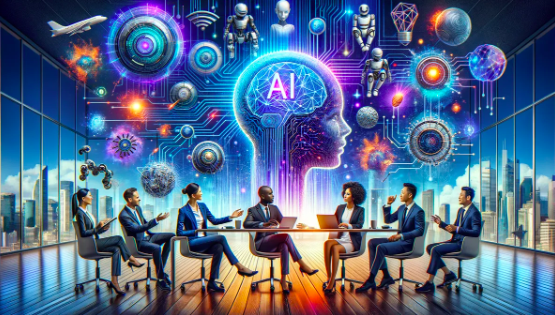
In recent years, Artificial Intelligence (AI) has evolved from an experimental technology into a core foundation of strategic development for many global enterprises.
Previously, AI was often viewed as a “future technology trend” or a “data-analysis support tool.” Today, it has become central to strategies for innovation, optimization, and growth.
According to 2025 reports from McKinsey, Deloitte, and Google Cloud, more than 60% of large enterprises have integrated AI into their operational strategies—a figure that continues to rise rapidly.
2. Why AI Has Become an “Indispensable Element”
a. Creating sustainable competitive advantage
Early adopters of AI can make decisions faster, more accurately, and more cost-effectively. AI enables businesses to analyze customer data, predict market trends, personalize products, and optimize operational costs.
Example: Amazon uses AI to predict purchasing behavior, helping reduce inventory and significantly boost revenue.
b. Automation and operational efficiency
AI is reshaping business operations. From customer-service chatbots and fraud-detection systems in banking to quality-control processes in factories, AI reduces labor costs and dramatically increases productivity.
c. Driving innovation and product development
AI not only optimizes existing processes but also enables the creation of new ones: smart products, personalized services, and data-driven business models.
Companies such as Google, Microsoft, and Vietnam’s VinBigData are leveraging AI to develop groundbreaking solutions in healthcare, education, and finance.
3. Strategic Transformation Within Enterprises
In the past, corporate strategy focused on people, products, and capital. Today, AI has become the fourth pillar—a “smart data foundation” that determines long-term success.
Modern enterprises no longer ask “Should we use AI?” but rather “How can AI align with our strategic goals?”
This shift is reflected in three common approaches:
- AI Transformation: integrating AI across all business processes.
- AI-First Strategy: designing strategies around data and intelligent models.
- Human–AI Collaboration: combining human creativity with machine computational power.
4. New Challenges and Requirements
The rise of AI also introduces strategic challenges:
- Data and privacy: AI is only powerful when fueled by high-quality data.
- Ethics and transparency: organizations must ensure responsible AI decision-making.
- Workforce reskilling: employees need new skills to work effectively with AI.
Thus, companies that succeed with AI invest not only in technology but also in people and a culture of continuous innovation.
5. Conclusion
AI is no longer a “technology of the future”—it has become a strategic foundation of the present.
Enterprises that know how to use AI to enhance productivity, understand customers, and innovate continuously will lead the digital era.
“In the new business landscape, AI is not just a tool—it is the strategic brain of the enterprise.”